
As a dog trainer, I always recommend walking your dog on a harness, not a collar, especially for puppies and dogs that pull.
Walking your dog with the leash clipped to their collar puts a lot of pressure on their neck. Even calm dogs pull sometimes. Maybe they see a squirrel, or maybe they get excited to greet another dog. When they lunge forward, that collar yanks right against their throat.
That pressure can hurt your dog. It can press on their windpipe and make them cough or gag. It can also strain the muscles in their neck and back. And since we walk dogs every day, that pressure keeps building up and can cause serious injuries and other long-term effects.
Negative effects of walking your dog on the collar:
- Physical risks: tracheal collapse and windpipe damage, neck and spine strain, thyroid gland damage, increased eye pressure (intraocular pressure), esophagus and larynx bruising, etc
- Behavioral risks: pain and discomfort from pulling on a collar can create a negative association. If a dog sees another dog, lunges, and feels a sharp pain in their throat, they can start linking other dogs with pain, making reactivity worse over time.
A harness solves this problem. Instead of pulling on your dog’s throat, a harness spreads the pressure across their chest and shoulders. Those areas are much stronger. Your dog stays comfortable, and you still have good control on your walk.

Think of it this way:
A dog collar is for ID Tags,
and a harness is for the Leash!
Health reasons why walking a dog on a collar and leash is a bad idea
Collars put pressure on the dog’s neck and trachea. The neck is a very sensitive part of your dog’s body. It’s especially dangerous for dogs that pull or lounge on the leash, or for puppies, since their bodies are still developing and more fragile.
Health problems associated with using a collar and leash include neck vertebrae problems, trouble breathing, coughing, respiratory issues, collapsing trachea, worsening spinal problems, or orthopedic diseases.
Certain breeds are especially at risk: toy breeds (chihuahuas and yorkies), dogs with flatter faces (French bulldogs and pugs), and long-bodied breeds (dachshunds). Always use a well-fitted harness with those breeds.
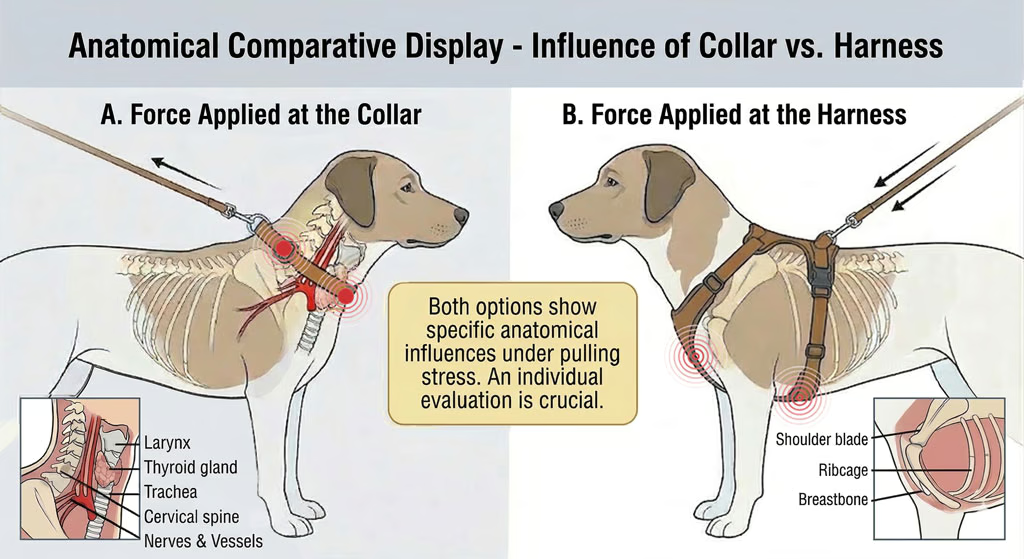

The collar creates neck pressure, which results in discomfort and trouble breathing
Dogs who pull or lounge on a leash are in constant discomfort due to collar pressure
In my experience with dogs, any pressure on the neck area creates a drive and makes a dog who pulls pull even more. Vicious circle! If your dog is young and energetic, curious about everything, or not yet trained to walk politely on leash, they will pull most of the walk. On an hour-long walk, that means long-term neck discomfort, limited breathing, and sometimes even choking.
Choosing a harness over a collar is better for health and more humane. Why let our dogs suffer? Even if your dog is a strong puller, the harness will disperse pressure over a wider area of the chest, shoulders, and upper back. A dog’s chest is much stronger than a dog’s neck! (After you switch to a harness, it is not a bad idea to book some training sessions with a dog trainer; leash manners can be achieved with a few sessions!)

A collar is NOT okay when your dog pulls on a leash
Collar pressure can create unwanted behavior problems
If your dog is experiencing neck pain or trouble breathing because of collar pressure, we can’t expect good behavior. Think of the day when you had a migraine, cramps, or a stomach ache – how nice were you to the people around you, or how motivated were you to perform your work? Probably not so much.
Now imagine your dog lounging on a leash and barking at another dog: they bark because they are probably scared or heightened, and we add restraint and neck pressure to the mix. Discomfort and stress will make the dog pull the leash even harder, hence even more discomfort or even pain, maybe even choking at some point.
And we expect our dog to stop barking and just chill? Not happening! Not only will the dog not stop pulling or barking, but they are also gonna act even worse over time. Right now, they bark because they are scared, but also because they associate meeting other dogs with being choked.
A negative connection like that is hard to break and will require a lot of training (hire a force-free trainer who doesn’t use a choke collar, since choking your dog doesn’t really solve the issue); the first step would be to buy a harness and start work on leash manners and leash reactivity.


But don’t harnesses teach dogs to pull?
You might hear people say that harnesses teach dogs to pull, like a sled dog. The truth is, harnesses don’t teach pulling. Dogs pull because they are excited to sniff and explore, and they haven’t learned loose-leash walking yet.
Pulling happens with collars too, except a collar just chokes the dog when they do it. With many strong pullers, a collar makes pulling much worse. As a trainer, I work with all dog sizes, breeds, and ages, and I have seen it over and over.
A harness will not make pulling worse, and it won’t stop pulling. But it will definitely keep your dog safe and comfortable while you teach them loose-leash walking skills.
Save this article to Pinterest to come back to it later

